Academic Digital Transformation Strategy
GreenStride Transformation Roadmap
A digital transformation roadmap moving a sustainable footwear brand from product-based advantage to capability-based advantage.
Academic work presented as evidence of research and analytical rigour. Recommendations are coursework outputs, not claimed commercial outcomes.
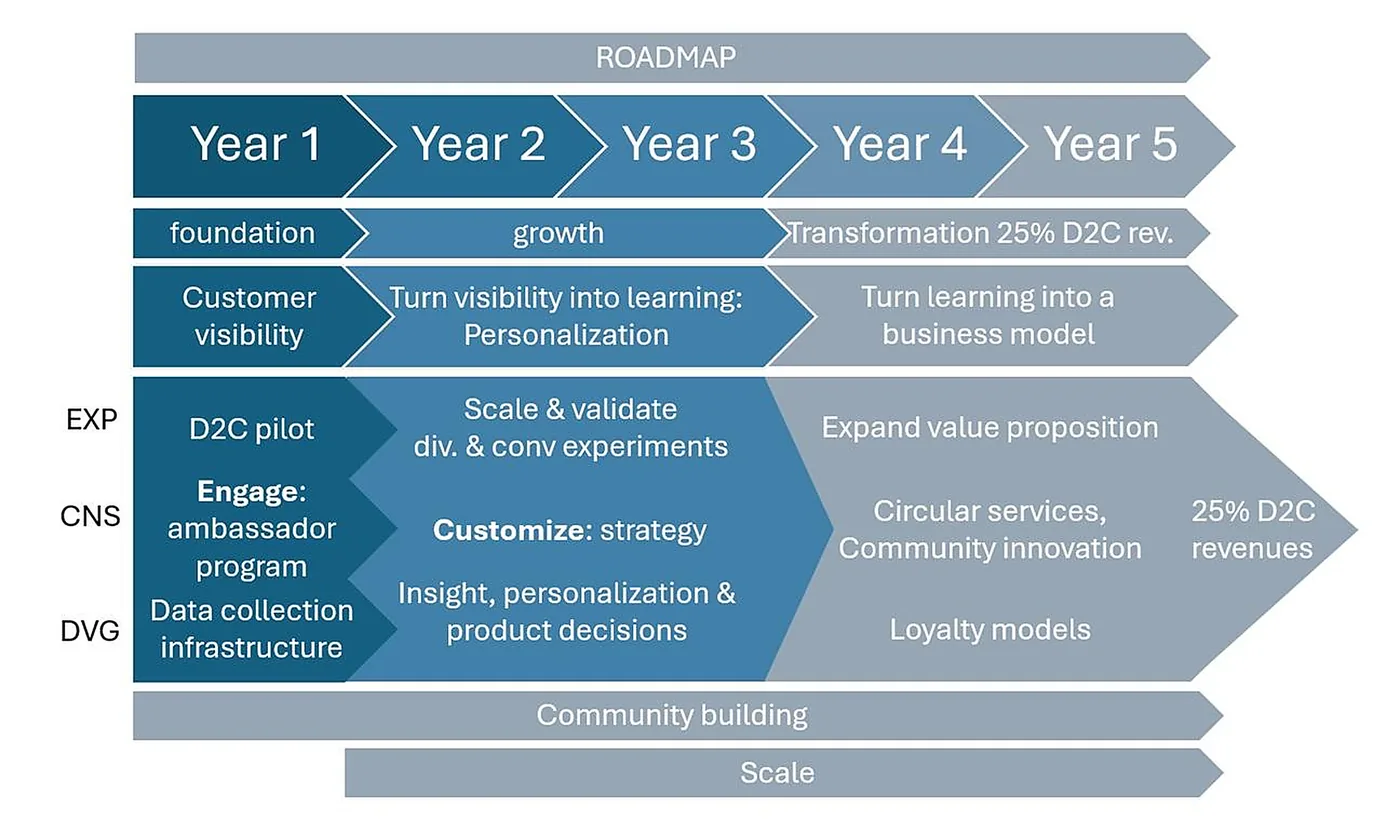
A Master in Management digital transformation roadmap moving a premium sustainable footwear brand from product-based advantage to capability-based advantage using Rogers' framework.
01
Context
GreenStride is a B Corp-certified premium sustainable footwear business with vegan-certified lines, a materials lab, roughly 5% share of the U.S. East Coast market and capacity for 500,000 pairs. By traditional measures it looks healthy.
02
Problem
96% of revenue comes through wholesale partners. That model delegates the customer relationship, the behavioural data and the long-term loyalty to intermediaries, while competitors compound first-party customer intelligence year after year.
There is no D2C channel, no customer data, no digital marketing capability, no analytics infrastructure and a website that has not been updated in eighteen months.
Great products. No idea who is buying them.
03
My role
Sole author of the report for the Digital Transformation for Business module, Master in Management, Maastricht School of Management (June 2026).
04
Approach
David Rogers' (2016) digital transformation framework is used as a diagnostic lens. The self-assessment scores GreenStride at 1–2 out of 7 across customers, marketing logic, brand advocacy, competition and cooperation, value creation, value proposition definition and performance metrics.
The reading of those scores is the argument of the paper: the gap is organisational capability, not technology.
- 01Customer Network Strategy Generator
- 02Data Value Generator
- 03Convergent and divergent experimentation
- 04Rogers' disruption diagnostic
05
Solution
A three-phase capability roadmap — foundation, growth, then transformation — targeting 25% D2C revenue, with organisational agility and performance metrics rebuilt alongside the channel rather than after it.
06
Thinking
The aggregator threat is tested against Rogers' disruption criteria and fails the first part, so it is strong competition and an intermediation threat rather than true disruption. That distinction changes the response: build direct customer relationships quickly, rather than mount a disruptive-response programme.
07
Skills applied
- Digital transformation strategy
- Organisational capability assessment
- Customer network strategy
- Data strategy
- Experimentation design
- Roadmapping
09
Current status
Academic project — Master in Management, Maastricht School of Management (June 2026).
Focus areas
- Rogers (2016) digital transformation framework as diagnostic lens
- Wholesale dependency reframed as a data and capability risk
- Customer Network Strategy Generator and Data Value Generator
- Convergent and divergent experimentation design
- Three-phase roadmap to 25% D2C revenue
- Disruption vs strong competition test on aggregator threat