Academic Strategy · Fintech · International Business
M-Pesa: The Netherlands–Kenya Corridor
Two Master in Management reports arguing that Safaricom's next growth curve is a corridor, not a country.
Academic work presented as evidence of research and analytical rigour. Recommendations are coursework outputs, not claimed commercial outcomes.
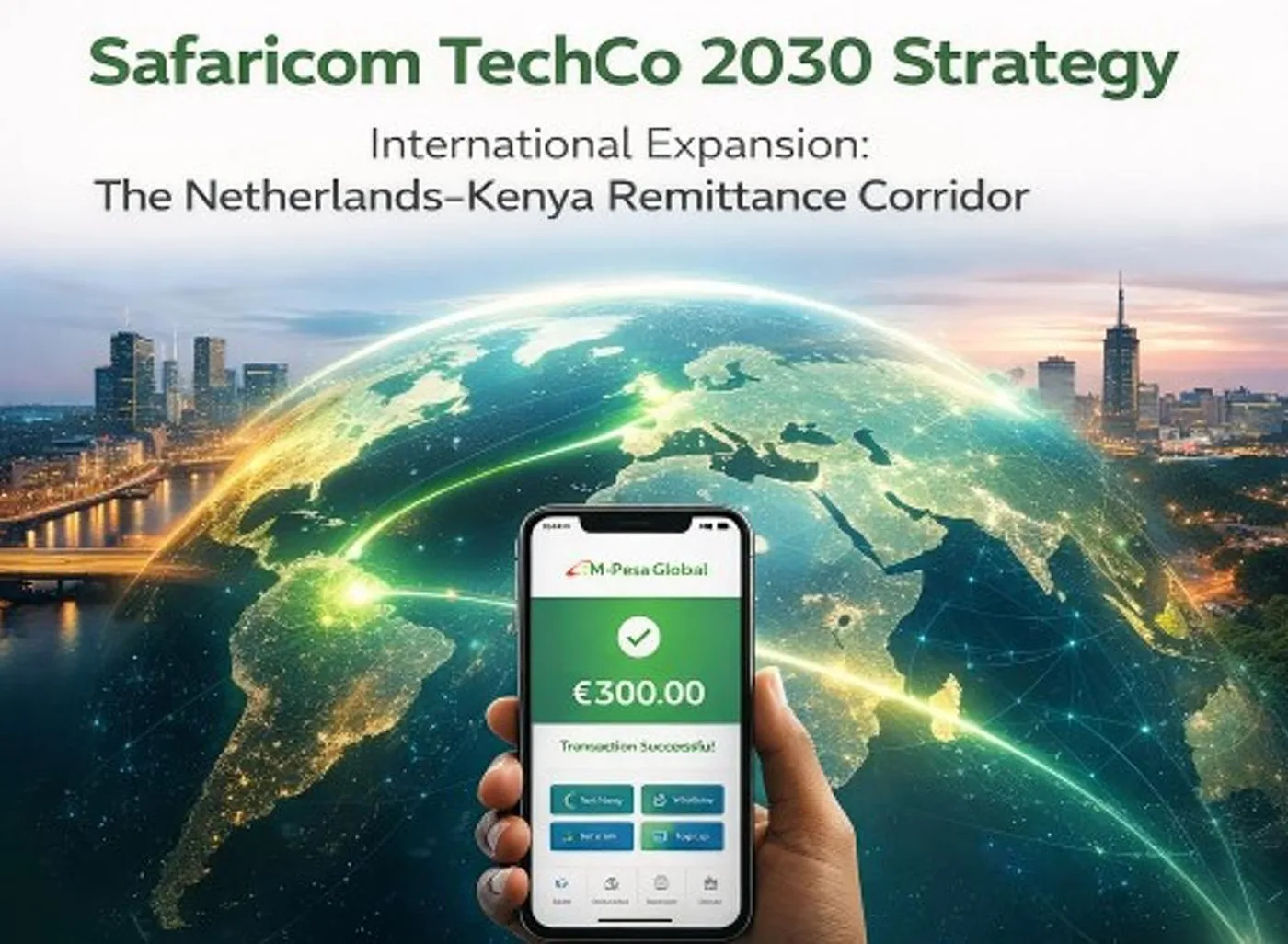
Two Master in Management reports for Maastricht School of Management proposing corridor-based internationalisation for Safaricom's M-Pesa: a marketing market-entry strategy and a strategy & planning advisory report.
01
Context
M-Pesa is one of the world's most studied mobile financial ecosystems: over 90 million customers across seven African markets, KES 38.29 trillion of annual transaction value and 44.2% of Safaricom's group service revenue in FY2025.
Domestically, though, the runway is shortening. Kenyan mobile money penetration stands at 91% and financial inclusion at 84.8%, so growth has become volume-based rather than user-based.
Domestic dominance now masks a growth problem.
02
Problem
If the domestic market is structurally mature and interoperability reforms have lowered switching costs, where does the next wave of advantage come from — and is Safaricom's advantage geographically bound or transferable?
03
My role
Sole author of both reports for Maastricht School of Management: the Marketing Management market-entry report (February 2026) and the Strategy & Planning individual advisory report (May 2026).
04
Approach
The strategy report applies twelve frameworks — PESTEL, Porter's Five Forces, SWOT and TOWS, VRIO, cost leadership versus differentiation, the BCG Strategy Palette, McGrath's Transient Advantage diagnostic and Gans, Scott & Stern's Entrepreneurial Strategy Compass among them — to test which resources travel across borders.
The marketing report works the other direction, from the customer inward: segmentation of the Kenyan diaspora in the Randstad, product life cycle analysis, a competitive positioning map and a full marketing mix.
- 01PESTEL — Kenya and Netherlands/EU
- 02Porter's Five Forces on the corridor
- 03VRIO resource and capability inventory
- 04BCG Strategy Palette posture selection
- 05Transient Advantage lifecycle
- 06Competitive positioning map
05
Solution
A controlled Netherlands–Kenya remittance corridor pilot. The positioning is a 'High Trust / Low Cost' quadrant against global utilities like Wise and legacy banks, built on M-Pesa's closed-loop, wallet-to-wallet settlement and its last-mile presence in Kenya.
The plan uses a transparent 1.5% flat fee, iDEAL integration for Dutch payers, a Communication Adaptation mode that keeps the platform standardised while shifting the message from 'financial inclusion' to 'convenience and connection home', and a Dutch Electronic Money Institution licence to manage PSD3, GDPR, AML and KYC exposure.
06
Thinking
The VRIO and Transient Advantage work is what turns this from an expansion wish into an argument: last-mile transaction infrastructure, the Fintech 2.0 cloud-native platform, regulatory legitimacy and closed-loop transaction intelligence are transferable assets rather than Kenyan ones.
Alternative options were explicitly rejected rather than ignored, and the recommendation is sequenced — pilot, then a scaling decision, then multi-corridor — so the commitment stays proportionate to what has been learned.
The advantage is transferable. The market is a corridor, not a country.
07
Skills applied
- Strategic analysis
- Market entry strategy
- Competitive positioning
- Regulatory and risk assessment
- Segmentation & targeting
- Advisory report writing
09
Current status
Academic project — Master in Management, Maastricht School of Management (2026).
Focus areas
- Corridor-based internationalisation instead of new-market land grabs
- 'High Trust / Low Cost' positioning vs Wise and legacy remitters
- 1.5% flat fee, iDEAL integration, Dutch EMI licence
- VRIO + Transient Advantage test of transferable capability
- Q3 2026 pilot, 2028 scaling gate, 2030 multi-corridor roadmap
- Risk register covering PSD3, GDPR, AML/KYC and trust erosion